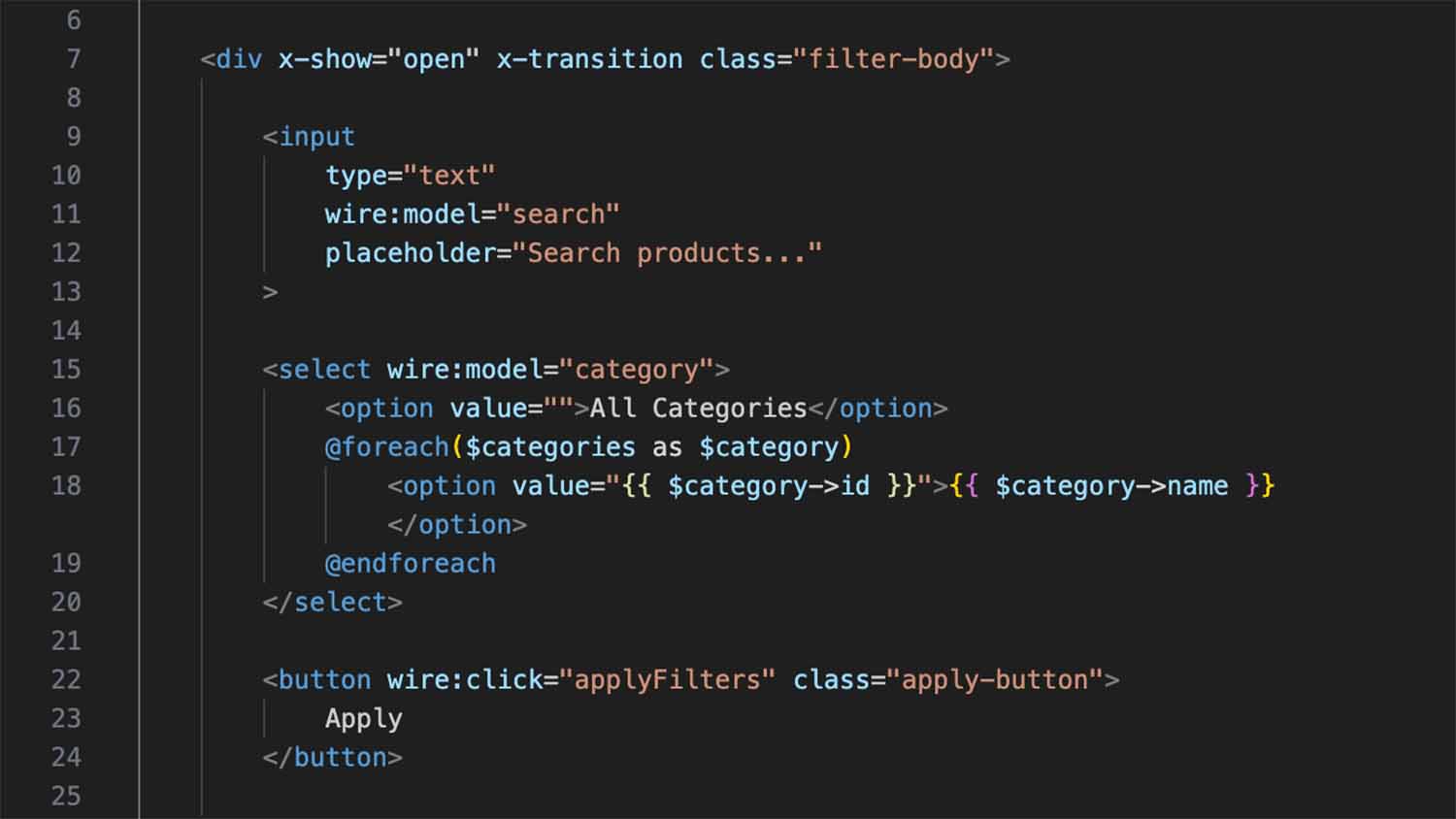
The same filter panel from the article: Livewire handling the query, Alpine handling everything else.
Alpine.js and Laravel Livewire Are Sibling Projects
One of the bugs behind a recent Alpine.js Tools update came from a Laravel Blade project: a developer named watkit reported the Alpine Focus plugin’s x-trap directive being flagged as unknown, traced to a naming mismatch between the plugin’s package name and the directive it actually registers. I don’t build Laravel applications myself. Alpine.js Tools supports Blade because people who do asked for it, so when a real bug report comes from that world, it’s worth understanding why the audience is there in the first place, not just fixing the bug and moving on to the next thing.
What that investigation turned up goes well beyond one bug report.
Rundown
- A real bug report, the Focus plugin’s renamed
x-trapdirective, came from inside a Laravel Blade project, prompting a look into why Alpine.js shows up in the Laravel ecosystem at all. - Alpine.js and Livewire, Laravel’s own official library for reactive interfaces, turn out to share a creator, Caleb Porzio, confirmed directly by Laravel’s own official blog. The two were designed together to split interactivity, not adopted into the same ecosystem independently.
- In practice, that split is simple: Livewire owns interactivity that involves the server, a filter panel querying a database and re-rendering results. Alpine owns everything that doesn’t, whether a panel is expanded, a value copied to a clipboard, a character count on a textarea.
- Tailwind, Alpine, Laravel, and Livewire together form a real, named pattern, the TALL stack, with a dedicated site, an official Laravel starter kit ecosystem supporting it, and courses built around it.
- GitHub’s own topic-tagging system shows a wide, diverse range of real Blade-based projects tagged with Alpine.js: dashboards, e-commerce admin panels, CRUD scaffolding, blogging platforms, warehouse management systems.
What the investigation found
Laravel’s own official blog confirms it directly: Caleb Porzio is the creator of both Livewire and Alpine.js, described as someone whose work spans “eliminating the JavaScript build step with Alpine to making real-time interfaces trivial with Livewire.” Alpine was built as the client-side companion for interactivity a server-driven tool like Livewire can’t cover on its own, closely enough that Porzio worked directly with Phoenix LiveView’s creator, the Elixir framework built around the same real-time idea, to keep Alpine integrating cleanly with that ecosystem too.
What that means in practice is a clean division of labor. A product filter panel is a common example: Livewire handles the actual filtering, a wire:model binding that queries the database and re-renders the results, while Alpine handles whether the filter panel itself is expanded or collapsed on mobile, UI state that has nothing to do with the database and doesn’t need to survive a page reload. A dropdown menu, a copy-to-clipboard button, a character counter on a textarea, none of that needs a server round-trip, and none of it has to route through Livewire’s request cycle to work. Livewire owns state that involves the server. Alpine owns everything that doesn’t.
The TALL stack
Tailwind CSS, Alpine.js, Laravel, and Livewire together are commonly referred to as the TALL stack, a real, established term with a dedicated site describing it as “a full-stack development solution, built by Laravel community members.” It’s taught directly, Laracasts runs a full course built entirely around the stack, and it shows up as a first-class option in Laravel’s own starter kit ecosystem: Laravel 12 introduced official support for community starter kits through the Laravel installer itself, and TALL-stack-based kits are a prominent category within it.
Not just starter templates
GitHub’s own topic page for Alpine.js filtered to Blade surfaces a genuinely diverse set of real repositories, not a handful of similar starter templates: dashboard admin panels, e-commerce applications with Filament-based admin, warehouse and delivery management systems, CRUD scaffolding packages, blogging platforms, healthcare management systems. That range is itself informative, this isn’t one narrow use case getting reused, it’s a general-purpose interactivity layer showing up across very different kinds of Laravel applications.
Frequently asked questions
Does a Laravel project need to install Alpine.js separately, or does Livewire include it?
Neither is required on its own, but Livewire ships with Alpine bundled by default, confirmed directly in Livewire’s own documentation: Alpine’s JavaScript is injected onto every Livewire page automatically, with no separate install step. A project can still bring its own Alpine build instead, custom plugins, extra stores, but out of the box, installing Livewire means Alpine is already there.
Does the TALL stack require Blade specifically, or does it work with other Laravel templating approaches?
Livewire components render through Blade views, so Blade is effectively part of the stack by construction. Alpine’s directives work the same way inside Blade as inside any other server-rendered HTML, there’s nothing Blade-specific about how Alpine itself functions.
Do Alpine and Livewire ever need to share state directly, or is the separation always clean?
Sometimes. Livewire’s $wire.entangle(), the modern replacement for the older @entangle Blade directive from Livewire v2, lets a Livewire property and an Alpine property stay synced in both directions, useful for something like a dropdown that needs to open instantly on the client but still needs its state available server-side for a later action. It’s a deliberate exception to the clean split described above, not a sign the split doesn’t hold generally.
Related reading
This connects to the case for Alpine.js over React on content-driven sites, the same small-interactivity niche Alpine fills here, just inside a different server-rendered ecosystem, and to why Alpine.js has no real autocomplete, and why AI doesn’t fix that gap, which applies to Blade files the same way it does to any other template language.